
Looking to unlock new value from your feedstock, catalyst or process? Have you considered microwave-enabled chemistry?
Industries and research groups ranging across chemicals, materials, energy and resource recovery are consistently seeking ways to optimise their processes. Whether it’s to improve efficiency, enhance quality and specificity or become more sustainable, the search for ‘a better way to do things’ is a constant.
Consistent work on process improvement often leads to small, iterative successes but organisations find themselves unable to reap the rewards potentially inherent in the next big idea, because the specialist facilities and expertise to evaluate it are often unavailable.
Microwave-enabled chemistry is a case in point. With conventional heating, thermal energy is conducted from the vessel wall into the material. In contrast microwave energy can be delivered directly into the material itself. This form of directed energy transfer can enable rapid, volumetric heating, helping to reduce thermal gradients and create more homogeneous heating profiles. In some applications, this can improve energy efficiency, enhance reaction selectivity, accelerate reaction rates and unlock reaction pathways that are difficult or impossible to access using conventional thermal approaches. For feedstocks, materials and catalysts that respond favourably, microwave energy has the potential to create entirely new opportunities for process development and optimisation. However, not every material, waste stream, feedstock or catalyst behaves in the same way under microwave conditions, so how do you determine whether these advantages can be realised in your application?
It’s a simple question but finding the answer can be a complex process. The only way to get to an answer is through practical experimentation. You could do this in house. That means new equipment and instruments, with all the regulatory fallout that accompanies buying new kit. It also most likely involves recruitment, training and a long ramp time. All this generates significant financial and time burdens that you’ll be feeling before you even start to capture data, let alone get to a definitive outcome.
Working with a microwave chemistry development partner
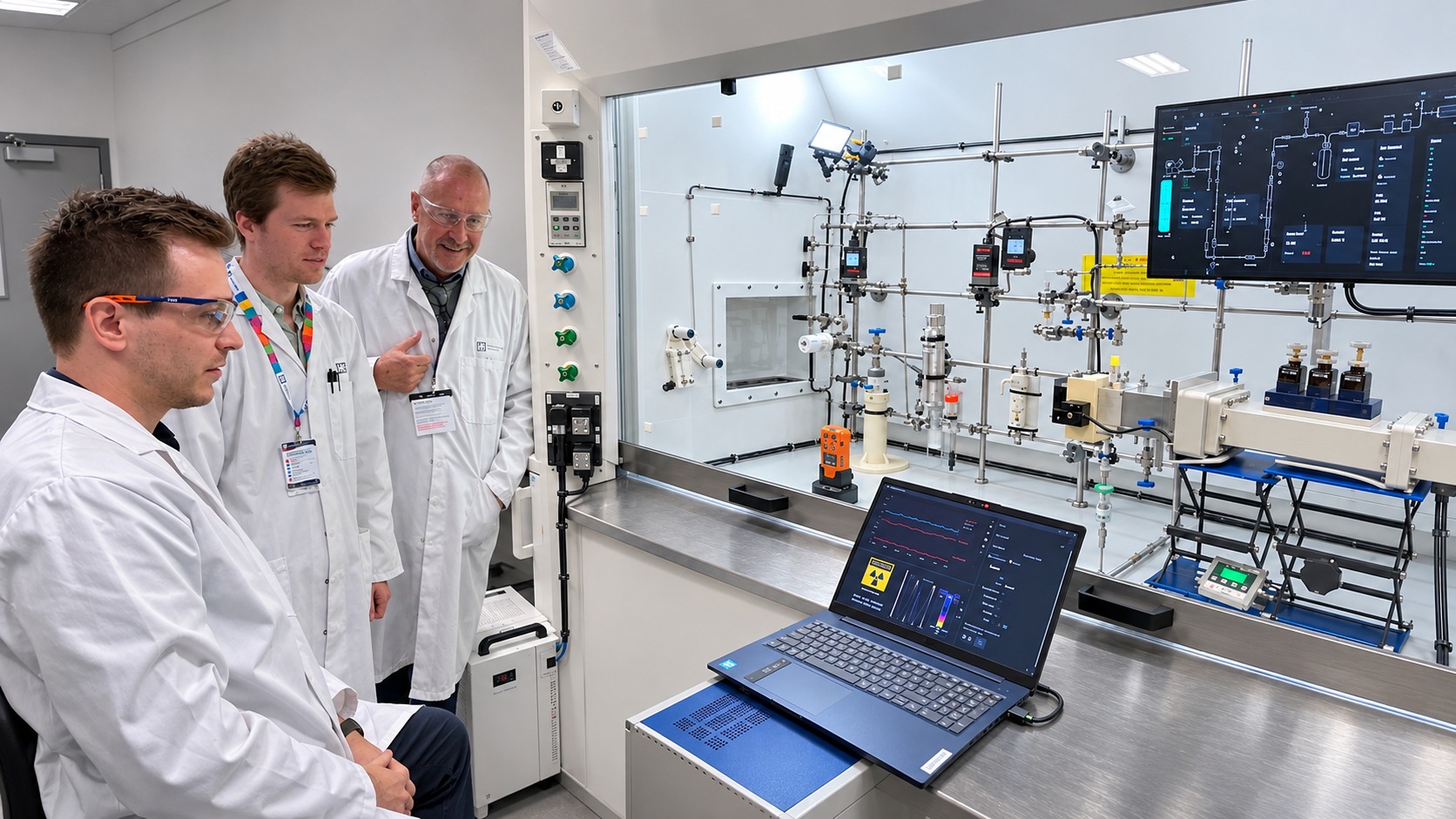
Our mission at MUOX is to help organisations explore the potential of microwave-enabled technologies without having to break the bank. You might be interested in investigating a new catalyst, evaluating alternative feedstocks, exploring waste-to-value or assessing how a material responds to directed microwave energy. Our team can work with you through a collaborative programme of feasibility studies to assess whether microwave energy could deliver meaningful benefits.
With a focus on robust science and evidence-based evaluation rather than assumptions and optimism, we work closely with our customers to develop and run laboratory-scale trials with the goal of understanding how your materials, feedstocks and processes behave when exposed to microwaves. These studies provide invaluable insights into a range of factors including temperature profiles, reaction performance, product formation and energy consumption.
For organisations looking beyond proof of concept, MUOX can offer a clear pathway from initial feasibility studies to pilot-scale evaluation. Our capabilities span the entire spectrum from sub-gram experiments to multi-kilogram processing, enabling us to help our customers develop a highly detailed understanding of technical feasibility and commercial viability.
What could microwave chemistry deliver for your process?
Microwave-enabled processes often behave very differently from conventionally heated systems. Understanding these differences early is essential before committing to further work. Our structured approach helps to answer the most important questions facing organisations when they are considering devoting time and resources to further development:
- Can microwave technology improve performance?
- How does energy consumption compare with conventional approaches?
- What products are formed and in what quantities?
- How do catalysts behave under microwave conditions?
- What opportunities exist for process optimisation?
- Can laboratory results be translated to larger scales?
Exploring new applications together
We are especially interested in working with organisations that have a focus on waste-to-value technologies, resource recovery and new routes to energy generation and storage. This could include applications involving plastic waste, biomass, agricultural residues, carbon-based feedstocks and other underutilised material streams. While these areas present complex technical challenges around process improvement they also offer some of the most exciting opportunities for innovation. Microwave-enabled approaches have the potential to play a pivotal role in applications across these sectors and we are keen to work with organisations looking to explore that potential.
We recognise that every project comes with its own objectives, challenges and uncertainties so, rather than just providing test results, we work closely with our partners to guide the evaluation process, helping to interpret findings, identify opportunities and shape future development plans.
We’re approachable, collaborative and friendly. If you have a catalyst, feedstock, process or waste stream that could benefit from a microwave-enabled approach, contact MUOX to discuss your microwave chemistry development project.